Photo: Jamie Kidston, ANU
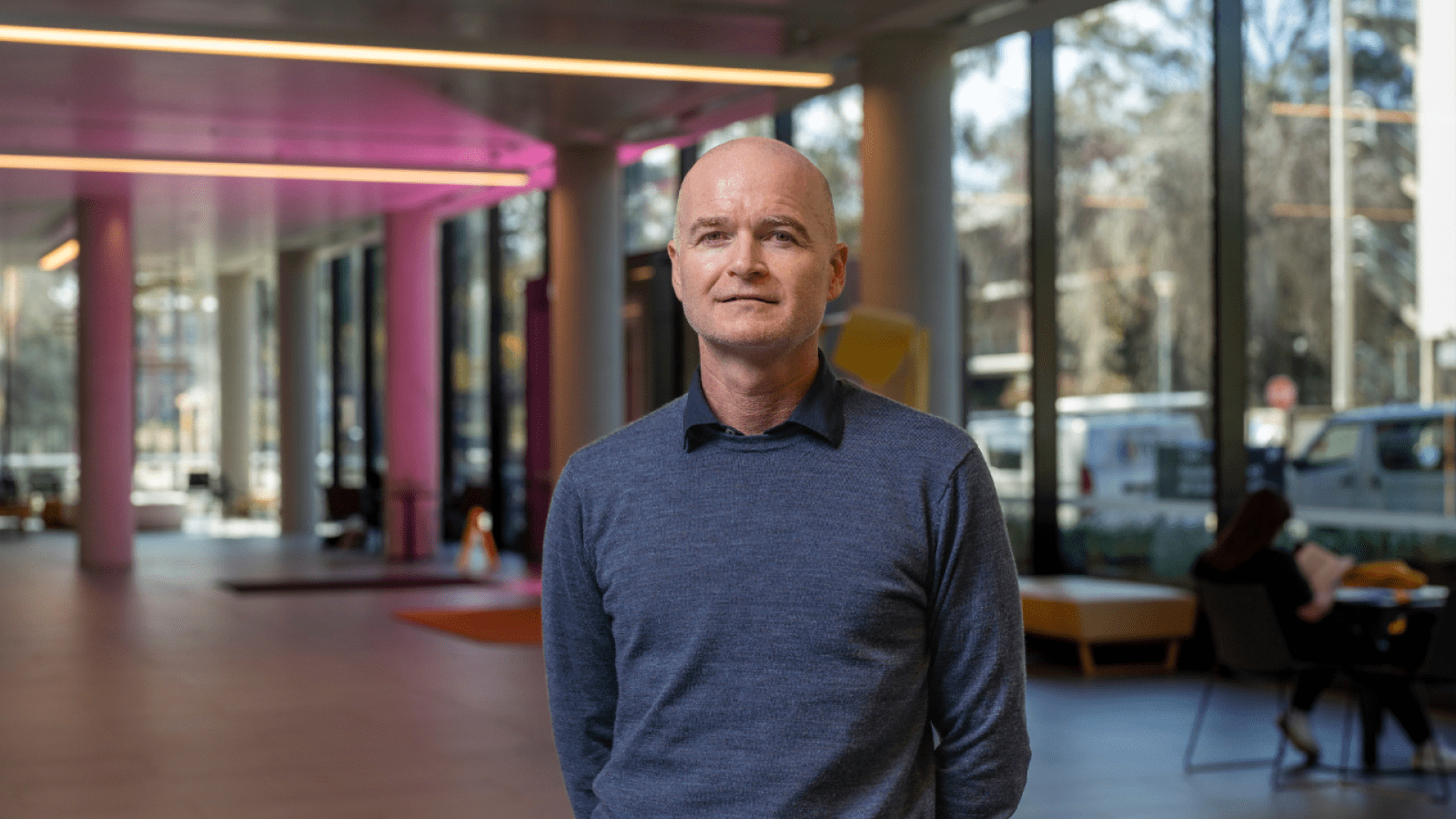
From working for Her Majesty, the late Queen Elizabeth II to leading the newly created ANU HASS Digital Research Hub, Professor James Smithies is on a mission to provide other academics with the digital research capability they need to thrive.
Originally published on ANU Reporter. Written by Luis Perez
When Professor James Smithies agreed to take on the biggest challenge of his career to date, he knew the outcome had to be fit for a queen.
Quite literally – the project was commissioned by none other than Her Majesty, the late Queen Elizabeth II.
Smithies, a New Zealand-born expert in digital humanities, is certainly not a royal insider. However, over the years, he’s built a reputation for leading teams of software engineers through digitally demanding research projects.
But what could the Monarch of England possibly want with a group of software developers? As it turns out, quite a lot.
“The Royal Family had decided to open up access to their royal archives to share an understanding of their history with the world through digital technology,” Smithies says.
At the time, he was Director of the King’s Digital Lab at King’s College London – an institution that became a key partner of this important mission.
The House of Windsor wanted to digitise the vast archive of King George III – a pivotal historical figure whom some may recognise from the Broadway musical Hamilton and his memorable song You’ll Be Back.
The scale of the task was immense: 425,000 pages of historic manuscripts, most never before released. Letters, financial records, menu books and an extraordinary range of documents stretching back centuries.
It was, truly, an undertaking of royal proportions.
“Stakeholder management was very complex, particularly when navigating relationships with the British Monarchy and the Royal Archives. Also, there was a large group of historians involved who had very high expectations about the quality and delivery of the digitised content,” Smithies says.
Ultimately, the team rose to the challenge, contributing to the creation of a unique digital resource that the Queen herself launched in 2015.
Since then, open access to these documents has transformed our understanding of British and American history.
Today, Smithies is back Down Under leading the newly established HASS Digital Research Hub at The Australian National University (ANU) – an initiative every bit as ambitious as his earlier endeavours.
Its mission: to give humanities and social science (HASS) researchers the digital backbone they need to secure major grants.
Digital excellence at home
While at King’s College, Smithies led one of the world’s leading teams of software engineers dedicated to humanities and social sciences research.
“Historically, these professionals were hired on insecure, short-term contracts. Around 2012, a grassroots push emerged to give people working with computers and research a professional identity. That’s when the term ‘research software engineer’ (RSE) was coined,” he explains.
In 2015, the ANU researcher encouraged his team at the Faculty of Arts and Humanities to identify as RSEs, a small change that made a huge difference in their work and aspirations.
A decade on, the HASS Digital Research Hub at ANU builds on that same philosophy, arriving at a moment when Australian universities are racing to catch up with Europe’s digital research capacity.
The new team offers far more than a commercial contractor ever could: they understand how academics think and work.
“We provide an intellectual collaboration – the kind you’d have with another academic colleague,” he says.
The Hub supports websites, data analysis, visualisations, archives, virtual reality and a wide range of computational methods. But its purpose goes beyond service delivery.
“Universities that want to retain their world rankings have to deliver computationally intensive research across all disciplines,” Smithies says.
“You can’t do this without managing practical issues like cyber security and sustainability. That’s why you need expert teams who can help colleagues develop and maintain their projects effectively.”
ANU researchers can come to the Hub with a clear plan or just a vague idea of what they need. Smithies’ team will then help them figure out what’s feasible, choose the right tools and map a path forward – all provided at no cost.
The team has experience working with historians, literary scholars, political scientists, demographers, and other researchers across HASS.
Their work is expected to play a key role in increasing grant success across the University.
“We will provide assurance to reviewers that the technical digital aspects of the project are world class,” Smithies says.
AI for good
The Hub is open to all kinds of technologies and methods, and artificial intelligence (AI) is no exception.
Smithies, however, wants to reassure the ANU community that his team understands the social and environmental impacts of these technologies and has no intention of importing the Silicon Valley culture and logic into his model.
“We are a centre of expertise at the assessment of AI and want to deploy AI for the good of humanities and social sciences,” he says.
“AI is a critical tool for us because it allows the Hub to support more colleagues and democratise technology across the University. But it’s important to stress that there’s a wide range of digital tools for HASS research that aren’t AI.
“We want to talk with colleagues about their values around technology and let them decide how they want to engage with it.”
A free resource for academics
Although hosted within the ANU College of Arts and Social Sciences, the Hub’s mandate is to support any researcher working in the HASS domain.
Smithies encourages any HASS researcher at ANU to contact his team for an initial conversation if they’re planning to apply for grant funding that has a digital component.
“Contact us early. Ideally three months before the deadline,” he says. “We want to build meaningful relationships and understand everyone’s projects.”
The Hub has an important role to play in the University’s future, underpinning research on issues of national importance – from social policy and national identity to Indigenous self-determination and the stewardship of cultural institutions such as museums and libraries.
“It’s really important for this Hub to develop digital research capability informed and guided by principles of Indigenous data sovereignty and technology management,” he says.
“Whether we like it or not, digital technology shapes how our generation experiences the world. It plays a fundamental role in society, culture and research and the ANU community now has a team to help them explore its potential.”
ANU Pro Vice-Chancellor (Research Infrastructure and Entities) Professor Tim Senden says the Hub offers “huge potential”, not only for the humanities and social sciences but also for the future of research more broadly.
“The real opportunity is in bringing the depth and nuance of HASS together with computational power to generate new insights across both HASS and STEM,” he says.
“Through the compound optics that James and his team are developing, I can see an elegant, human-centred fusion of HASS and STEM, one that will shape how we approach discovery into the future.”


